

Gear teeth can be produced entirely by grinding, entirely by cutting, or by first cutting and then grinding to the required dimensions. Usually, gear grinding is performed after a gear has been cut and heat-treated to a high hardness; grinding is necessary for parts above 350 HB (38 HRC), where cutting becomes very difficult.
Teeth made by grinding are usually those of fine pitch, where the amount of metal removed is very small. In addition, grinding of gears becomes the procedure of choice in the case of fully hardened steels, where it may be difficult to keep the heat-treat distortion of a gear within acceptable limits.
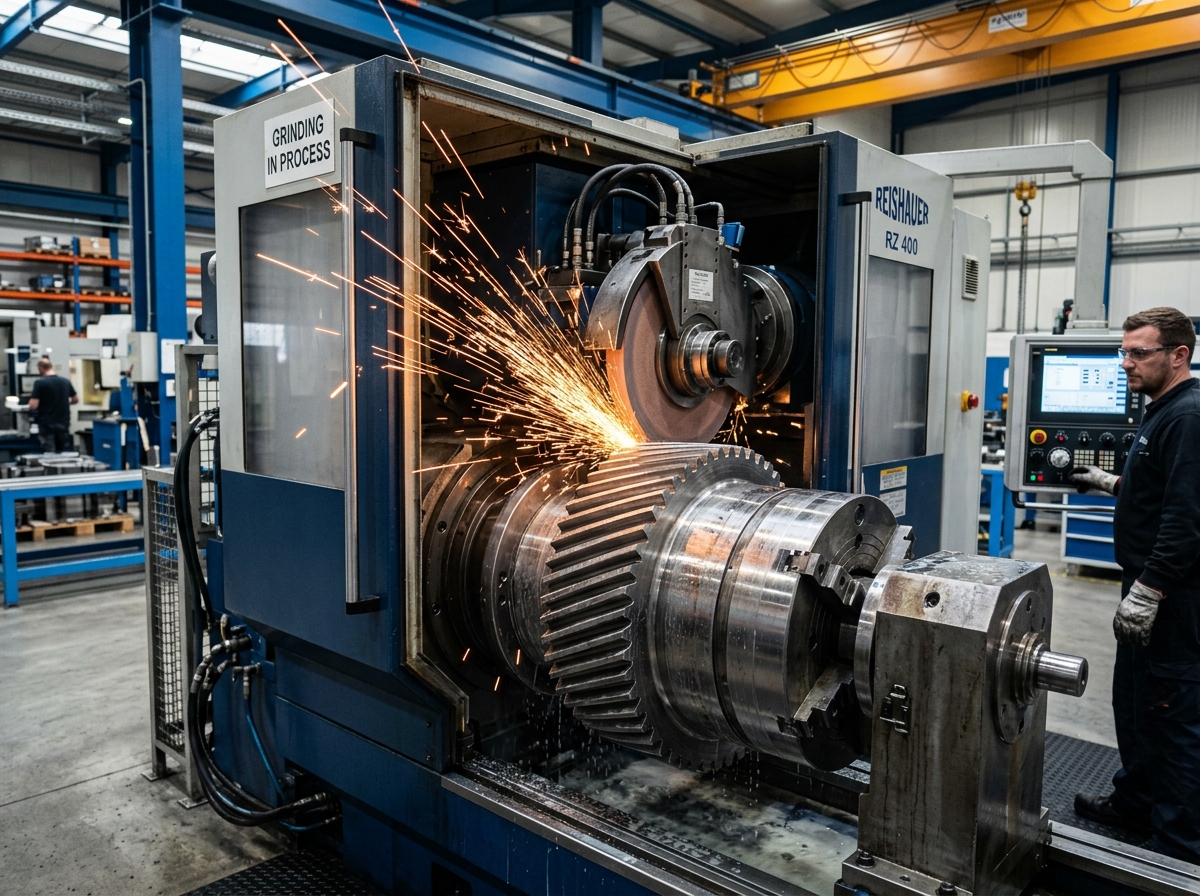
Understanding when gear grinding is the right manufacturing choice for optimal precision and cost-efficiency.
Essential for gears above 350 HB (38 HRC) where conventional cutting tools struggle to achieve the required tolerances.
Grinding is ideal when minimal metal removal is required, delivering superior surface quality on fine-pitch gear teeth.
Corrects heat-treat distortion in fully hardened steels, bringing gear geometry back within tight dimensional tolerances.
Saves tooling costs on expensive hobs, shapers & shaving cutters for medium-hard gears while achieving desired surface finish.